
(Thoughts on 1 Corinthians 3:11)
Listen to the song
holyscriptures - No Other Ground (1 Corinthians 3:11)
In the church at Corinth a curious thing was happening. The people had split. Factions had formed, oriented less around the gospel than around the names of its preachers. One cried, “I follow Paul!” Another, “I follow Apollos!” A third, “I follow Cephas!” And a fourth, apparently more spiritual than the rest, “I follow Christ!” (1 Cor. 1:12). Paul meets this party spirit not with a new program, but with a simple declaration:
1 Corinthians 3:11
“For no one can lay any foundation other than the one already laid, which is Jesus Christ.”
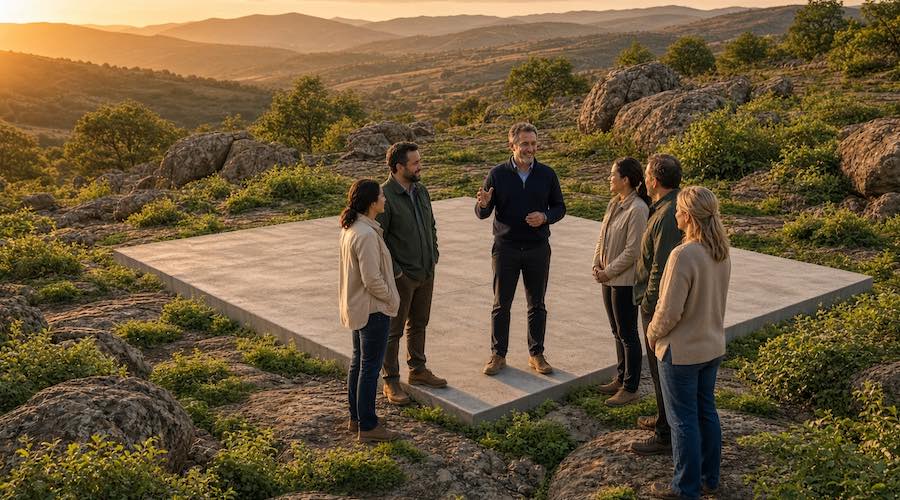
Picture a job-site meeting in which the architect tells the assembled owners that the foundation is already in place and is not up for discussion. Anyone who suggests they might replace it with something better suited to personal taste or the latest trends is told, politely but firmly, that the idea is not only impossible but absurd. The foundation has been laid. It stands rock-solid. It is Jesus Christ himself.
Paul is using the language of building, which he had already joined to the image of farming: he planted, Apollos watered, but God gave the growth (vv. 6–7). Now he shifts to the picture of a structure. The church is God’s building (v. 9). Paul, as a wise master builder, laid the foundation; others build upon it. What matters is not who is building, but what is being built upon—and how.
Imagine owners who decide, during a renovation, that the foundation is an unnecessary formality so long as the façade looks modern and the interior is tastefully done. They could raise beautiful walls, hang golden lamps, and roof the whole thing with the newest theological materials. Yet if the solid ground is missing or has been replaced, what remains in the end is collapse—the collapse that the fire of testing will mercilessly expose (vv. 12–15). Gold, silver, and precious stones endure; wood, hay, and straw burn. The builder himself will be saved, “but only as through fire.” It is a phrase that leaves little room for self-satisfaction.
Paul draws a clear line: there is only one foundation that has been laid. Everything else—persons, programs, traditions, or private insights—may serve as building material, but never as the foundation. Whoever tries to lay another foundation does not merely miss the mark; he undermines the house that God himself is building. The Corinthians may have found this too simple. Simplicity, however, is no weakness when it corresponds to the truth.
Today, when churches sometimes quarrel more over matters of style, favorite preachers, or timely adaptations than over the one foundation, the verse sounds like a friendly yet unmistakable reminder. We may build differently. One plants, another waters, a third raises walls, a fourth sets windows. God alone gives the growth. The foundation remains, always, Christ. Everything else, when we look closely, is only decoration. Jesus is the only load-bearing solution heaven has ever offered. We may build everything else upon him— but we should take care that it can withstand the fire.